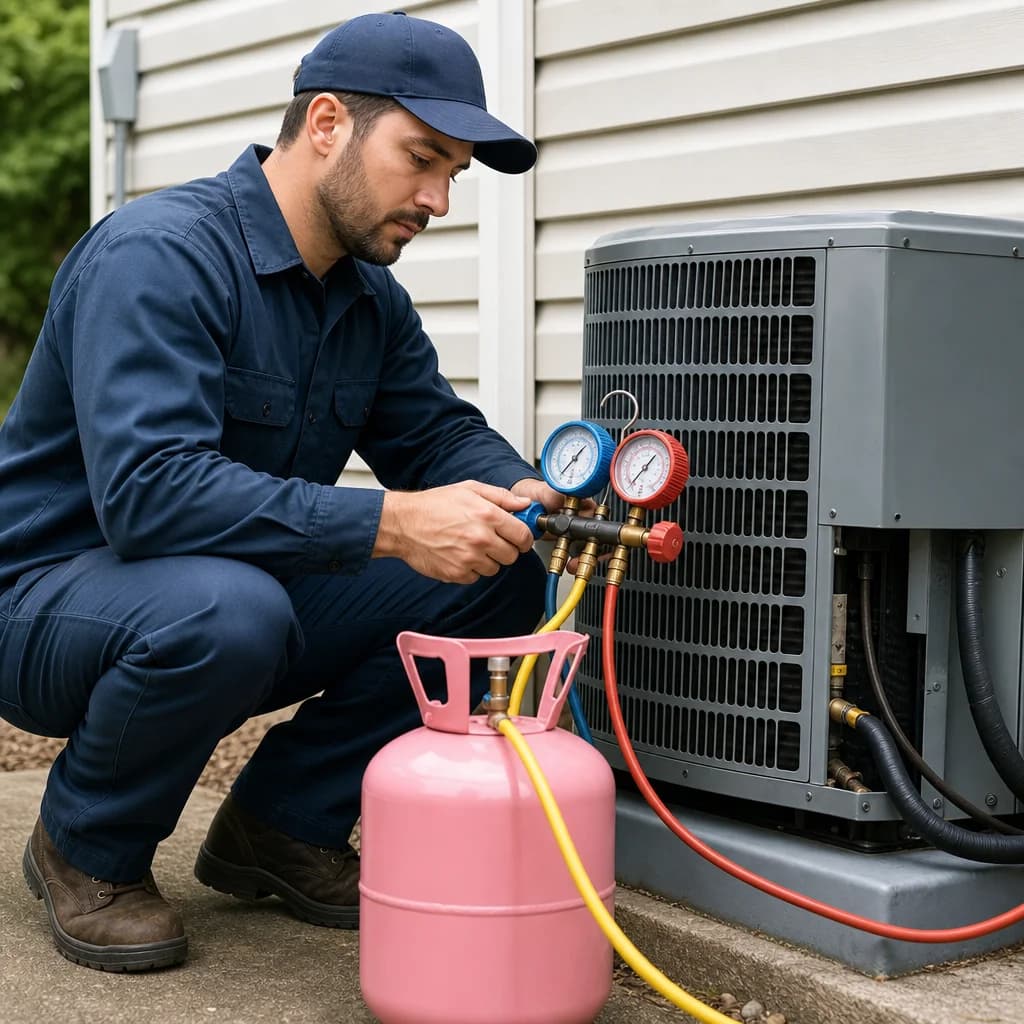
R410A has been the standard refrigerant for U.S. residential and light commercial air conditioning for roughly two decades, and millions of installed systems still depend on it. If you service split systems, heat pumps or mini-splits, R410A is part of your daily work.
At the same time, the market is changing. The federal HFC phasedown and rules affecting newly manufactured equipment are pushing new systems toward lower-GWP refrigerants such as R32 and R454B, which affects supply, pricing and long-term planning.
This guide covers what R410A is, where it is used, what influences its price, how it compares with R32, why refrigerants must never be mixed, what certification may be required, and how to buy with confidence.
What Is R410A Refrigerant?
R410A is a near-azeotropic HFC blend of R32 and R125 in a 50/50 mix by weight. It was developed as the successor to R22 in residential and light commercial air conditioning, and it has been the default refrigerant for U.S. split systems and heat pumps for roughly two decades.
Because it contains no chlorine, R410A has zero ozone depletion potential. It operates at noticeably higher pressures than R22, which is why R410A equipment uses different components, service tools and gauge sets.
Key characteristics at a glance
- Composition: 50% R32 and 50% R125 by weight, a near-azeotropic HFC blend
- Ozone depletion potential: zero
- Operating pressure: substantially higher than R22 — dedicated gauges and hoses are required
- Charging method: charge as a liquid from the cylinder to preserve blend composition
- Lubricant: designed for POE oil, not the mineral oil used in older R22 systems
- Common U.S. cylinder sizes: 25 lb and smaller service cylinders, plus pallet quantities
Common Uses In HVAC Systems
R410A is widely used in residential and light commercial air conditioning. If a system was installed in the U.S. between roughly 2005 and the early 2020s, R410A is the most likely charge.
- Residential split-system air conditioners and heat pumps
- Ductless mini-split and multi-split systems
- Packaged rooftop units on small commercial buildings
- Light commercial air conditioning in retail, office and restaurant spaces
- Some dedicated dehumidification and process cooling equipment
That installed base is enormous, which is why demand for R410A service gas continues even as new equipment moves to lower-GWP refrigerants.
A Changing Market: Regulations And Lower-GWP Alternatives
R410A is widely used in residential and light commercial air conditioning, but regulations and newer lower-GWP alternatives are changing the market. Under the AIM Act, the EPA administers a stepped phasedown of HFC production and consumption, and the agency has also adopted rules affecting the refrigerants used in newly manufactured equipment.
- New equipment manufacturing is transitioning toward lower-GWP options such as R32 and R454B.
- The HFC phasedown gradually reduces the volume of R410A that can be produced or imported.
- Servicing existing R410A systems remains normal practice — the installed base does not disappear because new models change.
- Reclaimed refrigerant is expected to play a growing role in meeting service demand over time.
Rules in this area are updated regularly. Before making purchasing or equipment decisions, review the current EPA HFC phasedown material and any state requirements that apply to your work.
Where To Buy R410A Refrigerant In The USA
R410A is sold through wholesale distributors, equipment suppliers and online refrigerant specialists. Each channel serves a different buyer.
Wholesale distributors
Local counters serve licensed contractors and are convenient for same-day pickup, but they typically require an account and pricing is not published.
Online refrigerant suppliers
Buying online gives you published pricing, clear cylinder sizes and direct shipping to the job site or shop. RefrigDirect ships factory-sealed R410A cylinders from a certified U.S. warehouse, typically within 1–3 business days.
- Factory-sealed cylinders in 2.5, 5, 7.5, 10, 11 and 25 lb sizes
- Multi-cylinder packs and pallet quantities for larger operations
- Free shipping on continental U.S. orders
- Transparent product specifications on every listing
- Compliance checks applied where certification requirements apply
R410A Price Factors
R410A pricing has been unusually dynamic in recent years. These are the variables that most influence what you pay.
- Allowance supply: the federal HFC phasedown reduces the volume that can be produced or imported each year, tightening availability.
- Cylinder size: a 25 lb cylinder almost always costs less per pound than a 2.5 or 5 lb service cylinder.
- Order quantity: packs and pallets typically carry better per-unit pricing than single cylinders.
- Season: demand climbs sharply during cooling season, and pricing usually follows.
- Freight and hazmat handling: refrigerant ships as regulated goods, so delivered cost includes real logistics expense.
- Equipment transition: as new systems move to lower-GWP refrigerants, service-gas demand patterns shift and affect pricing.
We publish live pricing on each product page rather than quoting fixed figures here, because the market genuinely moves.
R410A vs R32
R32 is one of the two components inside R410A, and it is increasingly used on its own in new equipment. The comparison below explains the practical differences.
R410A
- A blend of two refrigerants — must be charged as a liquid to keep the mix correct
- Enormous installed base across U.S. residential and light commercial systems
- Non-flammable under standard classification
- Higher GWP than R32, and included in the HFC phasedown
R32
- A single-component refrigerant, so composition cannot shift during charging
- Lower global warming potential than R410A
- Classified as mildly flammable (A2L), which changes equipment design, tooling and handling requirements
- Increasingly specified in newly manufactured systems
R32 is not a drop-in replacement for R410A. Charge each system with the refrigerant listed on its nameplate, using equipment rated for that refrigerant.
Compatibility Warning: Do Not Mix Refrigerants
Mixing refrigerants is one of the fastest ways to turn a small service call into an expensive equipment failure. It also makes recovery and reclamation far more difficult, because contaminated refrigerant cannot be cleanly reclaimed.
- Never top off an R410A system with R22, R32 or any other refrigerant.
- Never mix refrigerants inside a recovery cylinder.
- Charge R410A as a liquid — vapor charging a blend can shift its composition.
- Use R410A-rated gauges, hoses and recovery equipment because of the higher operating pressures.
- Use the lubricant specified by the manufacturer. R410A systems are designed around POE oil.
- If a system has lost its charge, find and repair the leak before recharging.
If you suspect a system contains a mixed or unknown refrigerant, recover it into a dedicated cylinder and label it clearly. Do not return it to a virgin refrigerant cylinder.
Certification And Purchase Requirements
Refrigerant sales in the United States are restricted, and the applicable rule depends on the product and its intended use.
- EPA Section 608 certification applies to technicians servicing stationary refrigeration and air conditioning equipment, including R410A systems. Categories include Type I, Type II, Type III and Universal.
- EPA Section 609 certification applies to motor vehicle air conditioning service, which is a separate program.
- Depending on the product type and use, proof of appropriate certification may be required before a sale can be completed.
- Venting refrigerant during service, maintenance, repair or disposal is prohibited — recovery equipment must be used.
- State and local requirements may go beyond the federal baseline.
The EPA publishes official guidance on the refrigerant sales restriction, Section 608 technician certification and the HFC phasedown. Review the current material before purchasing, since requirements are updated over time.
Shipping And Handling Considerations
R410A cylinders are pressurized and ship as regulated goods. A few practical points make delivery and storage go smoothly.
- Cylinders ship in approved packaging from our certified U.S. warehouse, typically arriving in 1–3 business days.
- Inspect the cylinder and its seal on arrival, and report any transit damage before use.
- Store cylinders upright and secured, away from heat sources and direct sunlight.
- Never heat a cylinder with an open flame, and never exceed the rated fill level.
- Wear safety glasses and gloves — liquid refrigerant can cause frostbite on contact.
- Work in a ventilated area, since refrigerant vapor displaces oxygen in confined spaces.
Why Choose RefrigDirect
We supply refrigerant to HVAC professionals across the United States, and the whole experience is built around getting the right cylinder to you quickly.
- Factory-sealed cylinders shipped from a certified U.S. warehouse
- A full range of R410A sizes, from 2.5 lb service cylinders to pallet quantities
- Free shipping on continental U.S. orders, typically delivered in 1–3 business days
- Clear specifications and published pricing on every product page
- Secure, encrypted checkout with order tracking
- Support from a team that works with refrigerant every day
Frequently Asked Questions
Is R410A banned in the United States?
R410A is not banned for servicing existing equipment. It is an HFC covered by the U.S. HFC phasedown under the AIM Act, and rules affecting newly manufactured equipment are moving the industry toward lower-GWP refrigerants such as R32 and R454B. Existing R410A systems can still be serviced.
Do I need EPA certification to buy R410A?
Refrigerant sales are restricted, and depending on the product type and intended use, EPA Section 608 certification may be required for stationary equipment refrigerant purchases. Confirm which requirements apply to you before ordering.
Can I use R32 in an R410A system?
No. R32 is not a drop-in replacement. It has different properties and is classified as mildly flammable, which requires equipment designed and rated for it. Always use the refrigerant listed on the system nameplate.
Why must R410A be charged as a liquid?
R410A is a blend of two refrigerants. Charging as a vapor can allow the components to leave the cylinder at different rates, shifting the composition of both the cylinder contents and the system charge. Liquid charging keeps the mix correct.
What size R410A cylinder should I buy?
For routine service work, 25 lb cylinders usually offer the best cost per pound. Smaller 2.5, 5, 7.5, 10 and 11 lb cylinders are convenient for top-ups and small systems. Contractors handling volume work often order multi-cylinder packs or pallets.
Can I top off an R410A system that is low on charge?
Low charge means there is a leak. Best practice is to locate and repair the leak, then recover, evacuate and recharge to the manufacturer specification. Repeatedly adding refrigerant to a leaking system is not an approved practice.
Will R410A get more expensive?
Pricing depends on allowance supply, seasonal demand and freight, so we do not predict future prices. What we can say is that the phasedown reduces available volume over time, which is why many contractors keep a working stock on hand.
How quickly do orders ship?
Orders placed on business days typically ship from our U.S. warehouse promptly, with most continental U.S. deliveries arriving within 1–3 business days and free shipping applied.
Recommended Products & Collections
Disclaimer: This guide is for general information only. Always follow federal, state, and local regulations and consult a licensed HVAC professional.