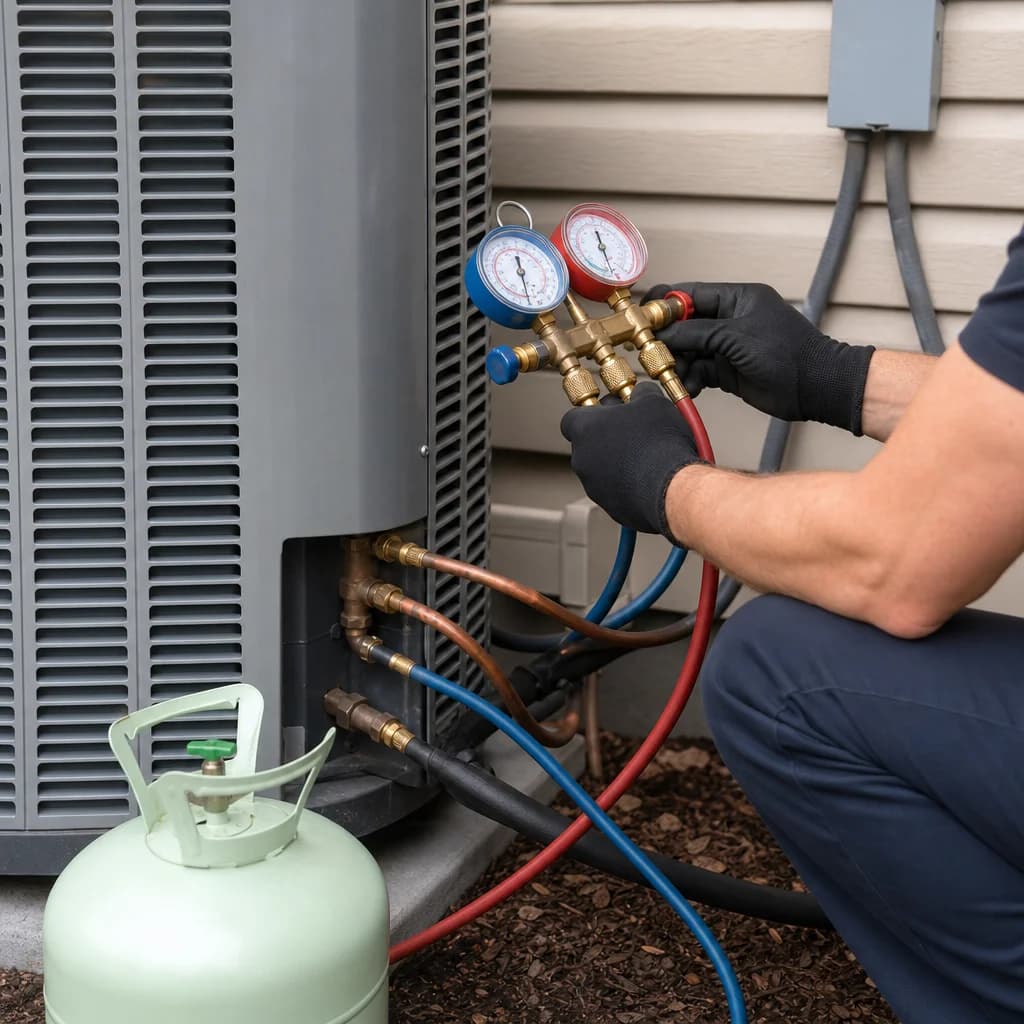
R22 powered U.S. air conditioning for decades, and millions of those systems are still running today. What changed is the supply: new production and import of most HCFCs, including R22, was phased out in the United States, so the market now runs on reclaimed, recycled and remaining existing material.
That shift creates real questions for equipment owners and technicians. Is R22 still legal to buy? What is reclaimed refrigerant? What certification is required? And at current prices, does it still make sense to recharge an older system instead of replacing it?
This guide answers those questions in plain language for U.S. buyers, and points you to the R22 and R22 replacement products we stock.
What Is R22 Refrigerant?
R22 (HCFC-22, historically sold under the Freon brand name) is a hydrochlorofluorocarbon refrigerant that served as the standard for U.S. residential and commercial air conditioning for decades. It is a single-component refrigerant, which made it straightforward to charge and service.
Because R22 contains chlorine, it has an ozone depletion potential greater than zero. That is the reason it was scheduled for phaseout under the Montreal Protocol and implemented in the U.S. through EPA rules on ozone-depleting substances.
Where R22 is still found
- Older residential split-system air conditioners and heat pumps
- Legacy commercial rooftop and packaged units
- Older commercial refrigeration equipment
- Some process cooling and specialty equipment still in service
The R22 Phaseout Explained
New production and import of most HCFCs, including R22, was phased out in the United States. The phaseout ran in steps: equipment manufacturers stopped building new R22 systems well before the final step, and the supply of newly produced or imported R22 was ultimately eliminated.
- The phaseout was implemented by the EPA under the Clean Air Act to address ozone-depleting substances.
- New R22 equipment manufacturing ended years before the production phaseout was complete.
- Since the phaseout, service demand has been met from recovered, recycled and reclaimed material and remaining existing stocks.
- Using R22 to service existing equipment was not made illegal by the phaseout — what ended was new production and import.
For authoritative detail, review the EPA material on the phaseout of ozone-depleting substances and the refrigerant sales restriction. Requirements can change, so verify current rules before you buy.
Why R22 Is Harder To Find
The shortage is straightforward supply and demand. Millions of R22 systems are still installed and operating, while no new R22 is being produced or imported in the U.S.
- Supply now comes from recovered, recycled and reclaimed refrigerant rather than new production.
- Reclamation is a processing operation with real cost, and volumes depend on how much material technicians recover.
- Demand stays high in summer, when older systems are worked hardest and leaks are discovered.
- As older systems are replaced, some recovered material leaves the pool permanently.
This is why R22 pricing sits well above where it did a decade ago, and why availability can be inconsistent from one supplier to another.
Is It Legal To Buy R22 In The USA?
R22 can still be purchased and used in the United States to service existing equipment, but it is tightly regulated. The phaseout ended new production and import of most HCFCs — it did not make servicing an existing system unlawful.
- Refrigerant sales are restricted under EPA rules, and appropriate certification may be required to purchase.
- Available R22 is generally reclaimed or recycled material, or remaining previously produced stock.
- Venting refrigerant during service, maintenance, repair or disposal is prohibited — recovery equipment must be used.
- State and local rules may impose additional requirements beyond the federal baseline.
Buyers should confirm legality for their specific situation, confirm whether the product offered is reclaimed or recycled, and confirm the certification requirements that apply before purchasing. We are happy to help you work through this before you order.
Reclaimed R22 Explained
Since new production ended, reclaimed refrigerant is a central part of how the U.S. market keeps existing R22 systems running. It helps to understand the difference between three terms that are often used loosely.
Recovered
Refrigerant removed from a system into an approved recovery cylinder. It has not been cleaned or tested, and it is not suitable for resale as-is.
Recycled
Refrigerant that has been cleaned on-site or at a service facility using filtration and separation to remove oil, moisture and acidity. It generally goes back into equipment owned by the same customer.
Reclaimed
Refrigerant that has been reprocessed to meet the AHRI 700 purity specification and verified by chemical analysis. Reclaimed refrigerant is the material that can be resold for general use, and properly reclaimed R22 performs comparably to previously produced material.
When buying R22, ask whether the product is reclaimed and whether it meets the AHRI 700 specification. Purity matters for compressor life.
Certification Requirements
Refrigerant sales in the United States are restricted, and the applicable rule depends on the product and its intended use.
- EPA Section 608 certification applies to technicians servicing stationary refrigeration and air conditioning equipment. Categories include Type I, Type II, Type III and Universal.
- EPA Section 609 certification applies to motor vehicle air conditioning service, which is a separate program.
- Depending on the product type and use, proof of the appropriate certification may be required before a sale can be completed.
- Refrigerant must be recovered rather than vented during service, maintenance, repair or disposal.
- Recordkeeping obligations may apply to certain purchases and service activities.
The EPA publishes current guidance on the refrigerant sales restriction, Section 608 technician certification, and the phaseout of ozone-depleting substances. Review it for your specific circumstances before ordering.
R22 Price Factors
R22 is priced very differently from current-generation refrigerants because its supply chain is fundamentally different. These are the main drivers.
- No new production or import: supply depends entirely on recovered, reclaimed and remaining existing material.
- Reclamation cost: processing to AHRI 700 purity and verifying it by analysis adds real expense.
- Cylinder size: 30 lb cylinders normally cost less per pound than 2.5 or 10 lb service cylinders.
- Seasonality: peak cooling season drives demand and tightens availability.
- Freight and hazmat handling: refrigerant ships as regulated goods.
- Order quantity: pallet and multi-cylinder orders typically improve per-unit pricing.
Because availability moves week to week, current pricing is shown on each product page rather than quoted in this guide.
Should You Recharge Or Replace The System?
With R22 costing considerably more than it used to, this decision comes up on almost every older system. There is no universal answer, but there are clear signals in both directions.
Recharging often makes sense when
- The system is otherwise in good mechanical condition and cooling well
- The leak is small, identified and repairable
- The equipment is not near the end of its expected service life
- You need to keep the system running while planning a replacement
Replacement is usually the better investment when
- The system leaks repeatedly and requires refrigerant every season
- The compressor or coil has failed, or repair costs keep climbing
- The equipment is roughly 15 to 20 years old or more
- Energy costs are high and a modern system would meaningfully reduce them
For systems that need to stay in service, some technicians evaluate R22 replacement refrigerants such as R438A (MO99), R422B, R422D or R427A. Suitability depends on the equipment, lubricant and manufacturer guidance, so confirm before making any changeover.
Where To Buy R22 Refrigerant
Because supply is limited, sourcing matters more with R22 than with any other refrigerant. Buy from suppliers who are clear about what they are selling.
What to look for in a supplier
- Clear statements about whether refrigerant is reclaimed, recycled or existing stock
- Published cylinder sizes and specifications on every listing
- Proper labeling and sealed packaging on arrival
- A compliance process that verifies requirements before shipment
- Reachable support if a question comes up mid-job
Buying from RefrigDirect
We ship R22 and R22 replacement refrigerants from a certified U.S. warehouse, typically within 1–3 business days, with free shipping on continental U.S. orders. Cylinder sizes and product details are published on every listing, and our team can help you confirm requirements before you order.
Safety And Handling
R22 cylinders are pressurized. Standard refrigerant handling practice applies, and the manufacturer safety data sheet is the authority.
- Wear safety glasses and gloves — liquid refrigerant can cause frostbite on contact.
- Work in a ventilated area, since refrigerant vapor displaces oxygen in confined spaces.
- Store cylinders upright and secured, away from heat sources and direct sunlight.
- Never heat a cylinder with an open flame and never exceed the rated fill level.
- Recover refrigerant with proper equipment. Venting is prohibited.
- Do not mix R22 with other refrigerants in a system or a cylinder — mixed refrigerant cannot be cleanly reclaimed.
Frequently Asked Questions
Can I still buy R22 refrigerant in the United States?
R22 can still be purchased to service existing equipment, but new production and import of most HCFCs was phased out in the U.S. Available supply is generally reclaimed or recycled material, or remaining previously produced stock, and refrigerant sales restrictions apply. Confirm legality and certification requirements for your situation before ordering.
Do I need certification to buy R22?
Refrigerant sales are restricted, and depending on the product type and intended use, EPA Section 608 certification may be required for stationary equipment purchases. Section 609 covers motor vehicle air conditioning work. Verify which applies to you.
Is reclaimed R22 as good as newly produced R22?
Properly reclaimed R22 is reprocessed to the AHRI 700 purity specification and verified by chemical analysis, and it performs comparably to previously produced material. The important part is confirming that what you buy has actually been reclaimed to that specification.
Why is R22 so expensive now?
Supply comes from reclaimed, recycled and remaining existing material rather than new production, while millions of R22 systems are still in service. Limited supply, reclamation processing cost, seasonal demand and hazmat freight all contribute to pricing.
Can I replace R22 with a different refrigerant in my existing system?
There are R22 replacement refrigerants such as R438A (MO99), R422B, R422D and R427A that technicians use in some situations. Suitability depends on the equipment, lubricant and manufacturer guidance, and any changeover must follow the correct procedure and labeling requirements. Consult a licensed HVAC professional first.
My R22 system is low on refrigerant every summer. What should I do?
Repeated loss means there is a leak. Best practice is to locate and repair it rather than recharge each season. Given current R22 pricing, it is also worth comparing repair cost against replacing the system with modern equipment.
Is it illegal to run an existing R22 air conditioner?
No. The phaseout addressed new production and import of most HCFCs, not the continued operation of installed equipment. Existing systems may continue to run and be serviced in accordance with applicable regulations.
How fast does R22 ship?
Orders ship from our certified U.S. warehouse, with most continental U.S. deliveries arriving within 1–3 business days and free shipping applied. Availability is confirmed at the time of order because R22 supply is limited.
Recommended Products & Collections
Disclaimer: This guide is for general information only. Always follow federal, state, and local regulations and consult a licensed HVAC professional.